

Sculpture in marble by Gian Lorenzo Bernini (1598-1680)
Galleria Borghese, Rome.
Created from ivory marble in 1621, The Rape of Proserpina is considered one of the most sensual works ever carved by Bernini. The statue was commissioned by the Cardinal Scipione Borghese, known for his somewhat scandalous taste in art. Critics for centuries have praised the raw emotion and movement to be found in the sculpture. Bernini’s attention to detail in his statue is, as always, unparallelled. It has been lauded most for the miniscule but most convincing details of Proserpina’s tears and the flesh of her leg and side giving way to Pluto’s strong grasp.
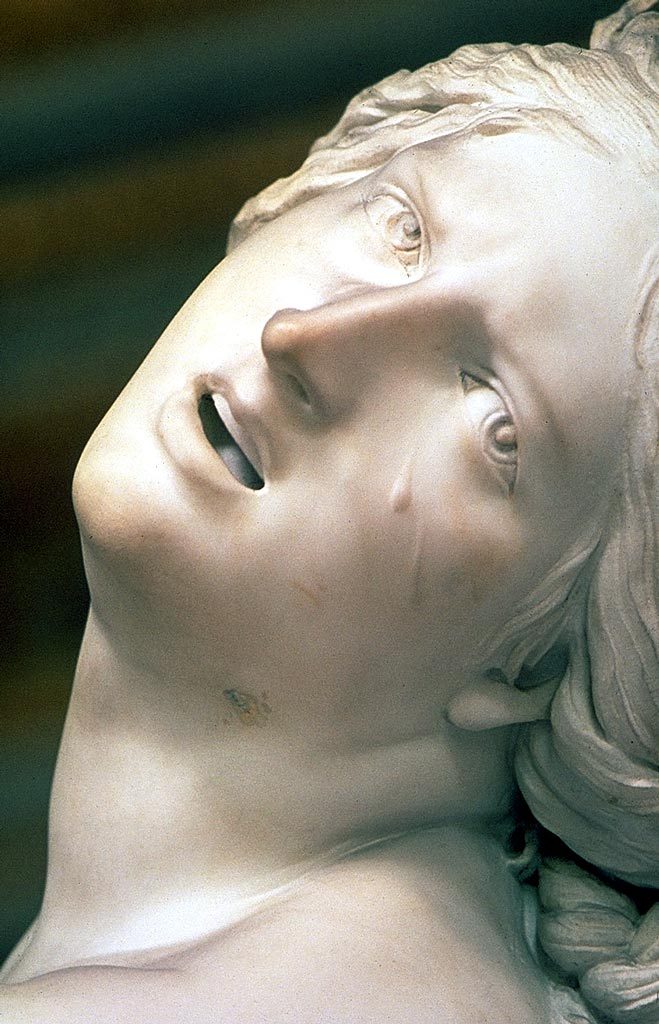


Again, the movement Bernini captured in this statue is considered unparalleled. The mixture of Pluto’s contrappasto pose and Proserpina’s figura serpentinata contrast with one another, inviting the viewer to imagine Pluto’s next swaggering step and Proserpina’s continued frantic twist away from Pluto. In a direct view, the two main subjects of the work can be seen. However, Bernini did not carve only two subjects in this work. There are two others which prompt closer consideration.
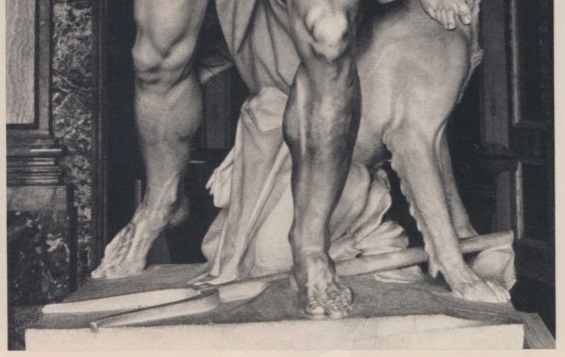
Between Pluto’s feet is his bident. The lesser known sibling of the trident, this pitchfork-like implement has been associated with Pluto for centuries. Some scholars say that the Big Three gods in Greek and Roman mythology share a numerically ranked power structure in their scepters. The belief is that Zeus/Jupiter’s lightning has a single prong, Hades/Pluto’s bident has two, and Posiden/Neptune’s trident has three prongs. In speaking of an ancient drawing of Jupiter in which he is shown with all three scepters, Arthur Cook says “Clearly he is concieved as sky-god (thunderbolt), sea-god (trident…), and earth-god (fork) rolled in to one–a diety competent to keep all evil at a distance”. (Cook, 803-804) These implements were seen as symbols of their power and their capability to protect. It is appropriate, then, that Pluto’s bident is laying abandonned underfoot because he has no intention of protection in this moment.

The final subject in Bernini’s excellent sculpture is our focus. The overshadowed animal. This is not meant in a demeaning sense but a literal sense. When the statue is viewed head on, almost everything about it can be immediately seen, one is not necessarily required to circle the piece to grasp all of its component parts. However, peeking out from under Proserpina’s right leg is the eye of a dog. Behind Pluto’s muscular leg is a strangely serpentine tail. The butt of the bident rests between the paws of a strange dog. Cerberus.
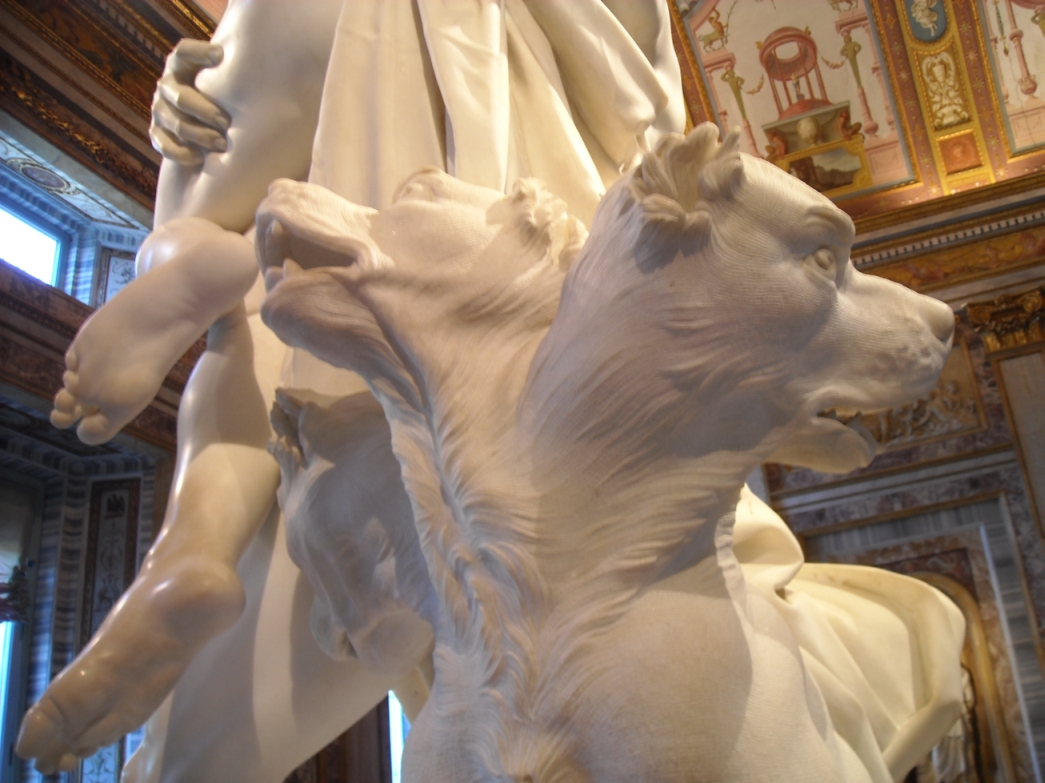
Cerberus is a unique figure in Greek and Roman mythology, shared between the two with no difference in name, aside from the occasional spelling of “Kerberos”. He is always native to the Underworld, companion to Hades or Pluto. He is sometimes referred to as “the hound of Hades” and his name could mean “evil of the pit” or “spotted”, etymologists disagree concerning the root of his name. Whatever the case, he is always the guardian of the Underworld, letting all shades in and no one out. He is the first obstacle mythological heroes face in their trips to the Underworld, from Orpheus to Aeneas. He is best known for being the last of Heracle’s Twelve Labors for King Eurystheus. Heracles was taksed with bringing Cerberus to the King’s court, either as a test of strength or simply as the King’s last attempt to stymie Heracles because he believed the task to be impossible. However, Heracles did succeed in dragging Cerberus to the surface in chains of adamant. According to myth, at the first sight of sunlight, Cerberus vomitted venemous saliva, from which the very poisonous aconite (monkshood, wolfsbane, etc.) immediately sprouted. Cerberus is a very famous mythological character. The question, however, is what is he doing in this particular sculpture?
Nowhere in the traditional myth is it stated that Pluto brought Cerberus with him to fetch Proserpina. Therefore, Pluto must be re-entering the Underworld. This would explain the sometimes-criticised jovial expression on Pluto’s face. He has made it back onto his home turf.

The remaining mystery, then, is why the particular expressions on Cerberus’s faces. While the left and right heads are calm and maybe even cautious, the center head is active and furious. Through the years, there have been theories that Cerberus’s three heads represent the three stages of life, infancy, youth, and old age. They could also represent past, present, and future. In either case, why is the center head so impassioned? Virgil, in the Aeneid, characterized Cerberus as “ravenous” as he ate the honeyed cake the Sibyl threw him in order for Aeneas to pass. (Virgil, 6.421) This interpretation was not taken lightly and Cerberus has since remained a symbol of hunger. Cerberus appears in Dante’s Inferno in the Third Circle of Hell as the tormentor of the gluttons, subdued by Virgil’s flinging of mud into his “famished jaws”, Cerberus consuming even earth. (Dante, 6.27) Bernini must have been aware of this symbolic meaning. Even though, in this time, “rape” and “kidnapping” had similar connotations, this statue is not the carrying off of a woman for a picnic. The statue contains distinct sexual tension and energy. Pluto’s intentions are revealed, in part, by his companion: the symbolic embodiment of hunger and lust.
Alighieri, Dante, and Franco Nembrini. Inferno. Milano: Mondadori, 2018.
Cook, Arthur Bernard. Zeus: A Study in Ancient Religion. Salt Lake City, UT: FORGOTTEN Books, 2016.
Maro, Publius Vergilius, Barry B. Powell, and Denis Feeney. The Aeneid. New York ; Oxford: Oxford University Press, 2016.
 Animals of Italian Art