
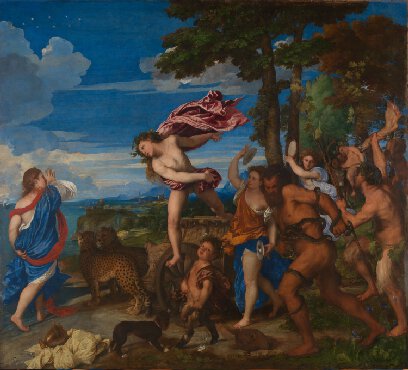
Bacchus and Ariadne, 1520–23
Oil on canvas by Titian (1488-1576)
National Gallery in London, England
This painting by Titian was commissioned by Alfonso d’Este, Duke of Ferrara for the Alabaster Room in the Ducal Palace (Gallery). It is based on a story found in a few sources, but specifically from Ovid’s Ars Amatoria. The purpose of Ovid’s book is “to teach young men to be bold in their efforts to seduce young women” (Heller). The poem states:
The god arrives.
Ovid, Ars amatoria, 1:547–549
In his chariot roofed with grape-clusters, he drives
A team of tigers with golden harness on.
In Titian’s painting, there are several animals. One man is covered in writhing snakes. A small dog faces a satyr. While we could examine the symbolism of these two animals, we have already explored the symbolism of snakes and dogs in other blog posts. There is a more significant and unexplored animal featured in Titian’s painting. Drawing the god’s chariot are two cheetahs.
Other paintings depicting the story of Ariadne and Bacchus, such as the paintings by Carracci and Giulio Romano, show tigers, just as it says in the poem by Ovid (Heller). Titian, however, chose to paint cheetahs. What is the symbolic purpose of cheetahs as opposed to tigers?
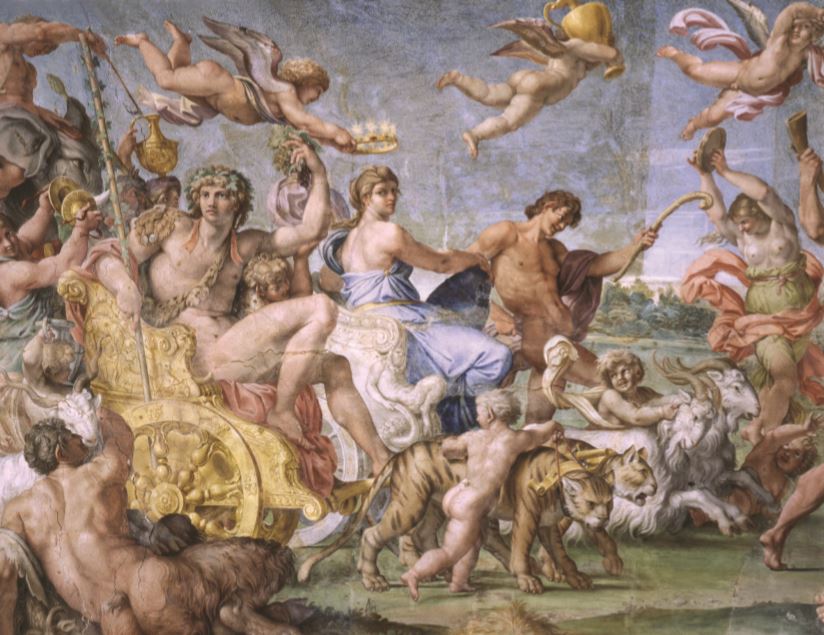

Images provided by “Rescuing Ariadne” by Wendy Heller.
This painting by Titian is not frequently the focus of scholarly discussion. Other paintings, such as The Rape of Europa, receive more attention for their symbolic meaning and ethical messages. However, there is one significant conversation among a few scholars which gives clarity of the use of cheetahs.
According to the National Gallery in London, “Alfonso d’Este is known to have had a menagerie at the palace in which he kept a cheetah or a cheetah-like member of the cat family” (Notes). This is corroborated by Erwin Panofsky, an American art historian. In his book Problems in Titian, he expressed two logical reasons for the choice of cheetahs. First, because Alfonso d’Este loved exotic animals, which is evidenced by his “menagerie” (Panofsky). Second, he argues that Titian meant to signify that Bacchus was arriving from India, because cheetahs, “as their Hindustani name implies, are an Indian species” (Panofsky).
This interpretation seemed to reign in the art community until the 1980s. Another scholar named Warren Tressider weighed in on Panofsky’s interpretation in his article, “The Cheetahs in Titian’s ‘Bacchus and Ariadne'”. According to Tressider, the Italian translation of the story that Alfonso d’Este read made no distinction between big cats. The story of Bacchus and Ariadne, told by more writers than Ovid, was in an Italian book called Imagines by Philostratus the Elder that was translated from Greek by a scholar named Demetrius Moscus (Colourex). It was this translation, read in Alfonso d’Este’s court, that specifically associated Bacchus with leopards (McStay).
This translation was thought to have been lost, but its recent discovery in the Bibliotheque Nationale in Paris enables us to understand why cheetahs appear in Titian’s painting…. Moscus…sometimes translates the Greek term into Italian as leopardo and sometimes as pardo. Nevertheless, he was not being any more inconsistent than his contemporaries because
Text provided by Colourlex.
pardo, panthera and leopardo appear to have been used in the
fifteenth and early sixteenth centuries to describe any of the
large cats…. Nevertheless, cheetahs, although rare, were in fact better known in Italy in Titian’s time than any other variety of exotic, spotted carnivorous feline. There is ample evidence to prove that they were used by the nobility (including that of Ferrara), as hunting animals.
Due to the information offered by Tressider, it seems unlikely that Titian chose cheetahs to indicate a return from India. Rather, the most likely scenario is that the translation used by Alfonso d’Este’s court did not specify between tigers and other big cats. Therefore, Titian painted cheetahs. While not technically the cat described in Ovid’s poem, it was beloved by the man who commissioned the painting. Through the debate summarized above, this conclusion has been accepted by the art community.
Heller, Wendy. “Rescuing Ariadne.” Early Music, vol. 45, no. 3, Aug. 2017, pp. 377–391. EBSCOhost, doi:10.1093/em/cax049.
McStay, Heather O’Leary. “Viva Bacco e Viva Amore”: Bacchic Imagery in the Renaissance. Columbia University, 2014.
Panofsky, Erwin. Problems in Titian, Mostly Iconographic: the Wrightsman Lectures under the Auspices of the New York University Institute of Fine Arts Delivered at the Metropolitan Museum of Art New York, N.Y. New York University Press, 1969.
 Animals of Italian Art