

Image from http://www.Caravaggio.org
Madonna and Child with St. Anne, 1605-1606
Oil on canvas by Michelangelo Merisi de Carravagio (1571-1610) Borghese Gallery, Rome, Italy
Michelangelo Merisi de Caravaggio is often called the first great representative of the Baroque Art period. An active artist beginning in 1593, he was finally commissioned to create this piece of art commonly known as Madonna and Child with St. Anne for St. Peter’s Basilica. The piece was specifically for the altar of the Palafrenieri (papal grooms). As St. Anne is their patron saint, the painting is also known as The Madonna of the Palafrenieri. Unfortunately, the piece was only displayed for a few days in St. Peter’s, most likely due to controversial depictions of the figures. The painting was then sent to the Palafrenieris’ church, but even here they did not wish to display it. Instead, they sold it to Cardinal Scipione Borghese for a small profit.
In this painting Mary and her small son (Jesus) crush the head of a serpent as St. Anne (mother of Mary) looks on from the shadows. The serpent represents Original Sin as represented in Genesis. A verse from the Bible discusses one who would crush the head of the serpent in Genesis:
I will put enmity between you and the woman,
Genesis 3:15 ESV
and between your offspring and her offspring;
he shall bruise your head,
and you shall bruise his heel.”
This piece of art depicts the 16th century Catholic belief of Mary’s role in the redemption of humankind. By giving birth to Christ, according to Catholic tradition, Mary redeemed mankind from Original Sin and became a ‘Second Eve’ by crushing the head of the serpent. However, the Martin Luther fought back saying that Christ alone could redeem mankind. In response to Protestant Reformation, the papal Bull of 1569 addressed this idea stating that Mary, along with the help of her child, bruised the head of the serpent. This painting clearly shows how the child steps on his mother’s foot to help crush the serpent. St. Anne looking on the two reinforces the idea of Mary’s importance and greatness. St. Anne was Mary’s mother and, from the moment Mary was conceived at the Immaculate Conception, Mary was pure and sinless.
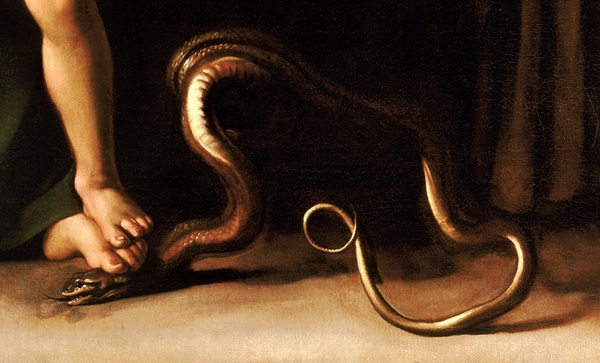
Detail Madonna and Child with Serpent
Furthermore, the serpent represents death and while Christ represents eternal life—the perfect incarnate. The serpent writhes in uneven, broken coils while Christ’s outstretched hand forms a perfect circle. Mary and St. Anne’s round halos also contrast the snake’s coils. Through Mary and Christ, death is overcome, and humankind is redeemed. Adding to the depth of meaning, this painting could have symbolized the Catholic tradition stepping on and conquering the new Protestant belief system. To claim both Mary and Christ redeemed mankind was an clearly Catholic belief. Consequently, the Catholic Church viewed those who had opposing opinions (the Protestants) as evil and sinful creatures that needed to be crushed.
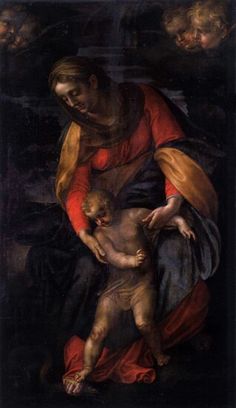
Madonna of the Serpant,1583, oil on canvas, Ambrogio Finino, 1548-1608,
Church of St. Antonio Abate, Milan, Italy
It is also important to note that Caravaggio may have been inspired by Ambrogio Finino’s Painting—Madonna of the Serpant (left). Some drastic differences include the uncovering of Christ and Mary and the addition of St. Anne.
There are varying controversies about the painting. First, the painting was commissioned by those who had St. Anne as their patron saint, but she is (literally) not depicted in the best light. She looks old and wrinkled. Second, Christ is depicted as nude. In the Baroque period, it was favored for figures in art (especially art that would be in churches) to be clothed as to prevent unwanted feelings. However, it would have been easy to cover him in St. Peter’s with a simple painted cloth as other figures in artwork had been covered in the past. Finally, what many believe was the controversy that caused the painting’s removal was the depiction of the Virgin Mary. Traditionally, Mary was depicted as angelic and pure, but here her revealing attire could have caused the viewer to see her as either relatable or promiscuous. She could have been viewed as a peasant stepping on a garden snake with her son. Caravaggio most likely painted her in this manner to portray a motherly nature.
Overall, Caravaggio’s depiction of Madonna and Child with St. Anne undoubtedly represents many important Catholic beliefs during the 16th century and depicts the style of Baroque Art. While it cannot be seen in St. Peter’s today, it can be seen in the Borghese Gallery in Rome, Italy.
Graham-Dixon, Andrew. A Life Sacred and Profane. Allen Lane, 2010.
Hibbard, Howard. Caravaggio. Westview Press, 1985.
Langdon, Helen. Caravaggio: a Life. Westview Press, 2000.
“Madonna and Child with St Anne 1606 – by Caravaggio.” Caravaggio, http://www.caravaggio.org/madonna-and-child-with-st-anne.jsp#prettyPhoto.
 Animals of Italian Art