
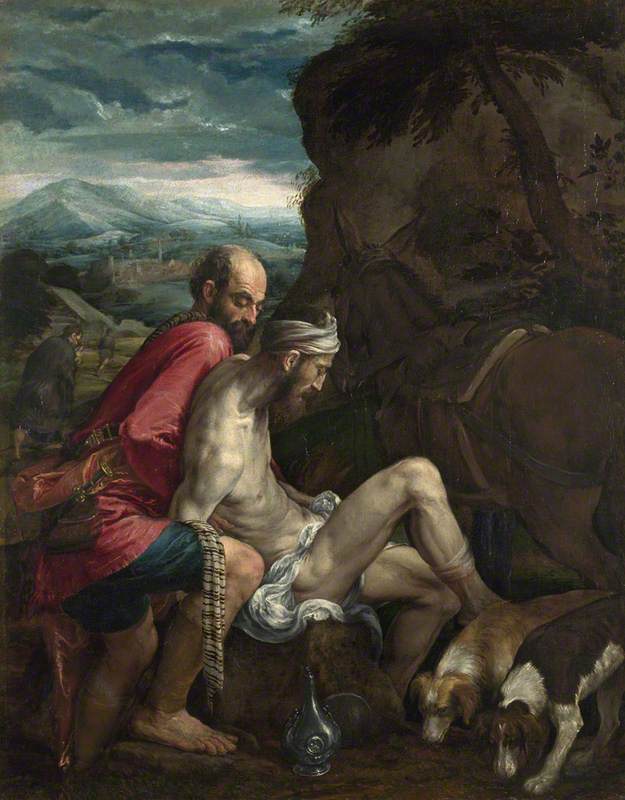

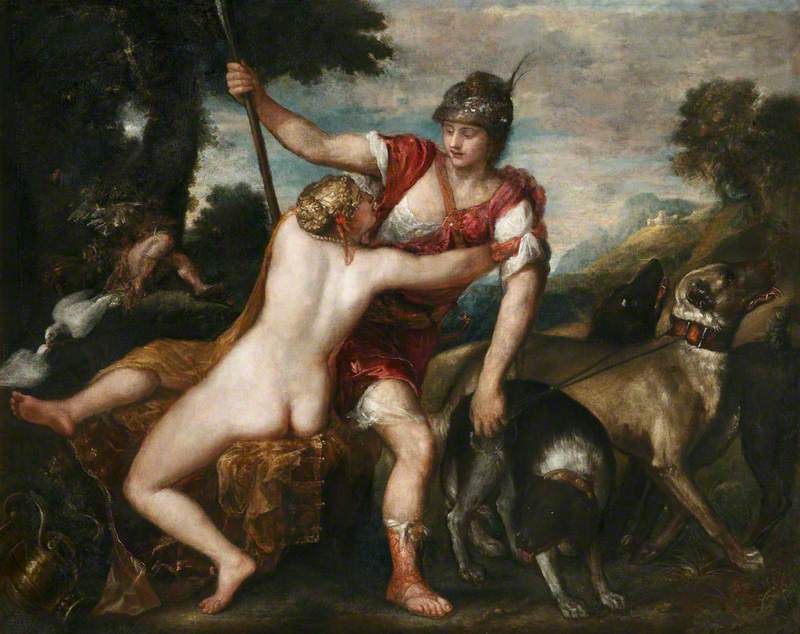
Various works of art depicting dogs within Renaissance paintings
The domesticated dog, or Canis lupus familiaris, has not always been regarded as a valued household pet. Throughout history, dogs were commonly seen as useful to their human owners, and thus included among the domesticated animal that served a human purpose. As a result, few dogs were included in art that depicted important events or people, and were rarely shown in the foreground (or main focus) of pieces that did include animal life. Dogs were around humans for a purpose, often hunting, herding, or guarding something for the desire of man. The modern idea of owning a dog only for the purpose of leisure and companionship was not commonplace in the ancient world, and those who did keep dogs for purposes of entertainment were amongst the wealthy and elite.
The use of dogs by humans and the portrayal of dogs in art began to change by the Renaissance era. Wealthy patrons who were able to support artists brought into public view their use of dogs. Dogs were “symbols of loyalty” and of high social status, as only the wealthy could afford to keep an animal as purely a pet. Of course, the rising aristocratic nature of Venice and of various merchant families throughout Italy, meant that the display of wealth was popular and important to those of high status (Uglow). Dogs were part of that display of wealth, and became accepted as normal for wealthy families. Thus, artists across Italy began to include dogs into the works of art that they were commissioned to do, even including them into biblically themed paintings and murals. Dogs had become the norm for Italy’s wealthy and they would feature in various works throughout the period of Renaissance culture.

The Wedding Feast at Cana, 1563
Canvas painting by Paolo Caliari, known as Paolo Veronese, (1528-1588)
Louvre Museum, Paris, France
Of the Italian Renaissance art depicting dogs, particular attention should be given to the works of Paolo Caliari (also referred to as Paolo Veronese, in reference to his hometown). Caliari painted dogs in a manner that defied some of the naturalism that was commonplace in canine depictions. Paolo Veronese preferred instead to depict his dogs in a manner that displayed “personality and character”, thus adding a sense of humor to his paintings. This “personality” can be seen within the dogs of The Wedding Feast at Cana, a biblical themed canvas painting of large scale and detail.
In the center foreground of the painting, two dogs are leashed together by a blue length of ribbon, which is attached to their collars. One dog stands at attention, looking towards a pitcher of wine next to a cat on the ground. The other dog is hunched on the floor, chewing on a bone, and thus inattentive to the events going on around him. The dogs are in the same middle prominence as the depiction of Jesus at the table, and are a focus of the viewer’s attention due to their isolated nature in the foreground. (Perhaps due to Caliari wanting to draw an equal level of attention to the dogs as to the Christ figure?) Other human activities of the wedding feast occur around the dogs, and the lavishness of the meal being served is not to be missed either.
Paolo Caliari’s piece is massive, measuring 6.77 meters in height and 9.94 meters in length. It was originally commissioned for the refectory (dining room) of the San Giorgio Maggiore monastery in Venice and was a significant commission for Caliari (François). The successful completion of the painting prompted other monasteries to commission similar works from Caliari, thus bringing him greater recognition.
The modern home of the painting is the Louvre in France. For the traveler interested in the work, its exact location within the museum is the Denon wing on the 1st floor within the Mona Lisa room, Room 711. The piece has been restored from its original creation in 1563, with restoration work being done from 1989 to 1992 to fix tears and fading colors within the work.

Two Greyhounds
Detail of The Wedding at Cana by Paolo Veronese (1528–1588)
Clark, Kenneth. Animals and Men: Their Relationship as Reflected in Western Art from Prehistory to the Present Day. William Morrow, 1977.
François, Aline. “Work-The Wedding Feast at Cana.” The Wedding Feast at Cana | Louvre Museum | Paris, Louvre, http://www.louvre.fr/en/oeuvre-notices/wedding-feast-cana.
Uglow, Luke. “Painting Dogs in Renaissance Venice.” Painting Dogs in Renaissance Venice | Art UK, Public Catalogue Foundation, 27 Apr. 2016, artuk.org/discover/stories/painting-dogs-in-renaissance-venice.
 Animals of Italian Art