
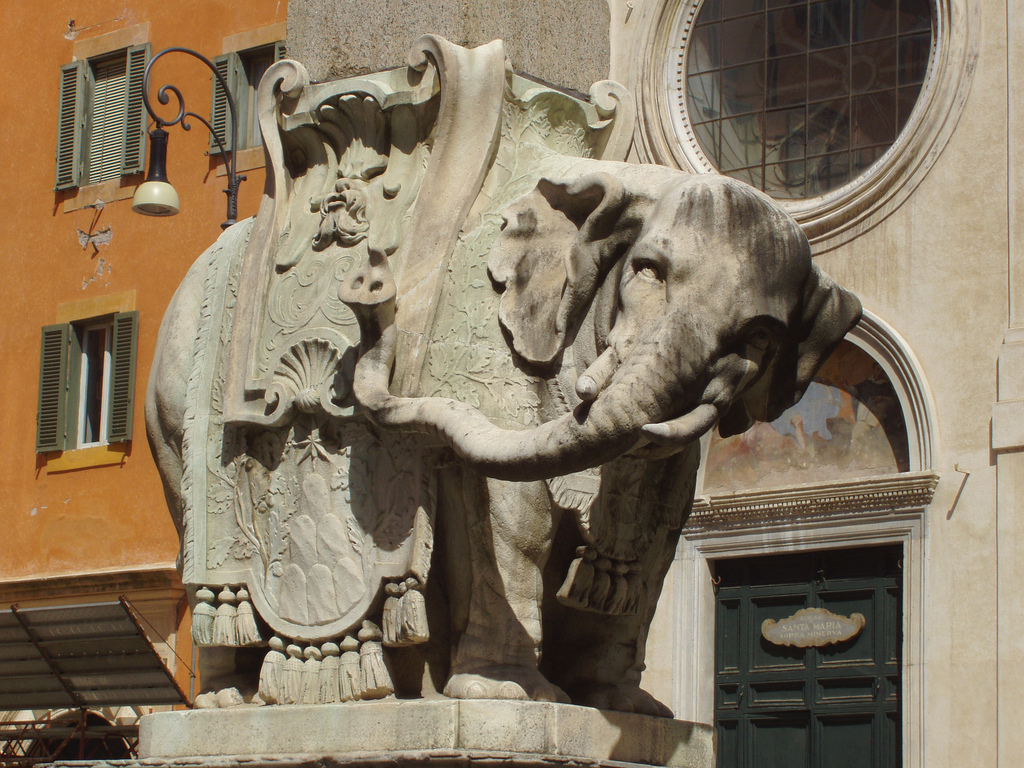
Image provided by Flickr. 
Image provided by Wikimedia Commons.
Elephant and Obelisk, 1666-67
Marble sculpture by Gian Lorenzo Bernini, (1598-1680)
Piazza della Minerva, Rome
In order to uncover the symbolism of the elephant in this piece, background must be established. This unique sculpture is made up of an Egyptian obelisk and an Italian elephant statue. The elephant was commissioned by Pope Alexander VII to carry the obelisk (Advancing Art & Design). It is one of a few Italian art pieces that focuses on an animal, as most animals are overshadowed by humans in Italian art.
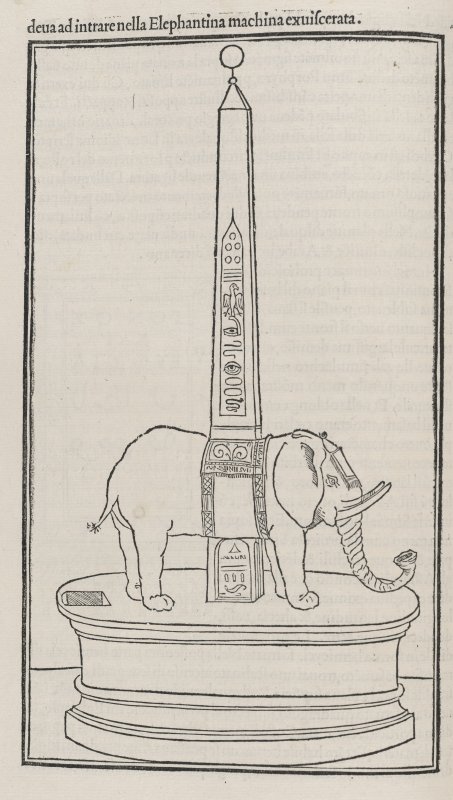
It is speculated that Bernini was directly inspired by a sketch in Hypnerotomachia Poliphili, which is a book from the Venetian Renaissance (University of Glasgow). The sketch is pictured to the left, and does share close resemblance to the Bernini sculpture.
There are multiple ways to interpret the use of an elephant in this piece. Within the historical context, it is possible the representation of the elephant is derived from the contents of Hypnerotomachia Poliphili. According to The Yale Peabody Museum, the elephant paired with the obelisk symbolizes, “proof that to uphold sound wisdom is the part of the sturdy mind,” which is a quote from the Latin inscription on the base of the piece (Echoes of Egypt).
According to Jen Smith at Mediterranean Meanderings, it was Pope Alexander VII who owned a copy of Hypnerotmoachia Poliphili and “it was he who had the Latin phrase inscribed on the base recalling the immense wisdom passed down from ancient Egypt” (Jen Smith). Specifically, the wisdom being passed through the obelisk to the elephant is the idea of resurrection, written about in the Egyptian Book of the Dead. The elephant could represent resurrection. However, though Smith claims that the belief was “transmitted” from Egyptian tradition to Christian tradition, this does not seem to have historical foundation (Jen Smith).
Without leaning heavily on the sketch that may have inspired Bernini, other conclusions can be drawn. Approaching the elephant from an ancient perspective offers the idea of strength and triumph. Elephants were used in ancient Rome for victory parades after conquering. Bernini may have chosen an elephant to remind travelers in the piazza of the successes of ancient Rome. As the elephant is carrying a foreign obelisk on its back, this seems a plausible interpretation (Impelluso 202).
Elephants can also be interpreted from a religious perspective. The obelisk the elephant is carrying is topped by the Pope’s insignia and a cross, so there could be religious tones to the choice of an elephant. According to Nature and Its Symbols, elephants are remembered for purity. When a pair of elephants are seen together, it can symbolize Adam and Eve before the Fall (Impelluso 202). However, since this elephant is alone, this is unlikely to be the intention of Bernini.
Another interpretation by Avigdor W. G. Posèq says the elephant is Pope Alexander VII himself (Posèq). This is not an insult. Rather, drawing on the earlier relation to war elephants, the elephant may represent a Christian soldier fighting evil (Posèq). Additionally, Posèq describes the elephant as having human facial characteristics, specifically Socratic (Posèq). The elephant has a large forehead and raised eyes which is reminiscent of ancient philosophers (Posèq). This would relate the elephant to philosophical intelligence, and would be a great compliment to the Pope.
The most frequent commonality between these interpretations is the strength of the elephant. Elephants are strong in physical stature and in mental prowess. These strengths could point to the Roman empire, the Venetian Renaissance, or Pope Alexander VII himself. In any case, the elephant is a splendid sculpture with a unique history.
Impelluso, Lucia. Nature and Its Symbols. Guide to Imagery. Los Angeles: J.P. Getty Museum, 2004.
Posèq, Avigdor W. G. “The Physiognomy of Bernini’s Elephant.” Source: Notes in the History of Art, vol. 22, no. 3, Apr. 2003, pp. 35–46. EBSCOhost, search.ebscohost.com/login.aspx?direct=true&db=asu&AN=505063841&site=ehost-live.
 Animals of Italian Art